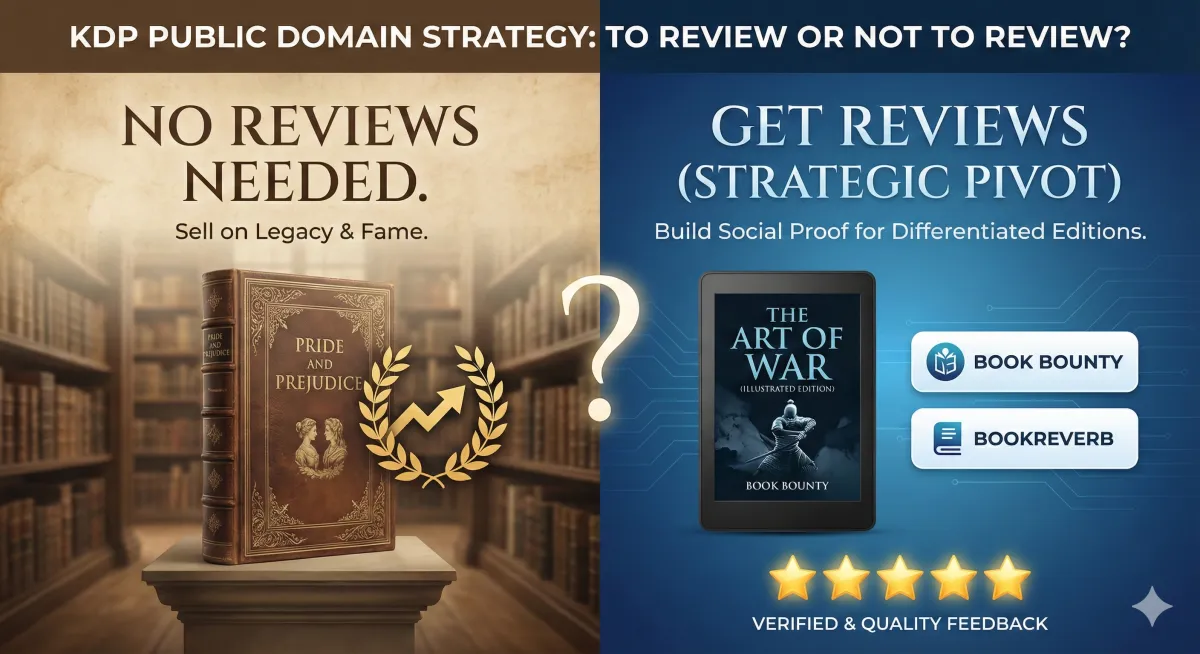
Do You Need Reviews for Public Domain Books on KDP? The Definitive Strategy Guide
Introduction: The Million-Dollar Question
Part 1: The "No Reviews" Strategy (Why PD Books Are Different)
1. The Power of Existing Marketing Value (EMV)
2. The "Review Merge" Phenomenon
3. What Actually Sells Public Domain Books?
Pillar A: The Cover (The Click)
Pillar B: The Metadata (The Visibility)
Pillar C: The "Value Add" (The Conversion)
4. The "Churn and Burn" vs. "Heirloom" Approach
Part 2: The "Yes" Pivot (When and How to Get Reviews)
Why It’s Effective for Public Domain
Why It’s Effective for Public Domain
Part 3: The Ultimate "Organic Growth" Public Domain Workflow
1. Selection: High Demand, Low Quality
2. Differentiation: The "Context & Visuals" Method
3. Publishing: The "Heirloom" Standard
Introduction: The Million-Dollar Question
If you are publishing public domain (PD) titles on Amazon Kindle Direct Publishing (KDP), you have likely agonized over the same question that keeps novelists and non-fiction authors awake at night: How do I get reviews?
In the world of original publishing, reviews are the lifeblood of sales. They provide social proof, signal the algorithm, and convince hesitant readers to click "Buy Now." But if you are publishing Pride and Prejudice, The Art of War, or Grimm’s Fairy Tales, the rules of the game are fundamentally different.
The short answer to "Do I need to get reviews on my KDP public domain books?" is no.
In fact, aggressively chasing reviews for public domain titles can sometimes be a waste of resources that could be better spent on cover design, formatting, and metadata. Public domain books sell based on Existing Marketing Value—the century of fame, prestige, and cultural recognition that the book already possesses—not on whether "Reader123" thought it was a five-star read.
However, the self-publishing landscape is nuanced. While you don't need reviews to sell these classics, having a few verified reviews can help your specific edition stand out in a sea of identical reprints. If you decide that social proof is the missing link in your strategy, there are specific, compliant ways to get them.
This comprehensive guide will break down exactly why the "No Reviews" strategy works for public domain, how to leverage Existing Marketing Value, and—if you choose to pursue them—the two best platforms to get compliant reviews safely.
Part 1: The "No Reviews" Strategy (Why PD Books Are Different)
To understand why reviews are less critical for public domain books, you have to understand the psychology of the public domain buyer.
1. The Power of Existing Marketing Value (EMV)
When a customer searches for a thriller, they might browse generic keywords like "psychological horror" or "mystery novel." In that scenario, they are looking for a good book, and they rely on reviews to tell them which one is good.
When a customer buys a public domain book, they are almost never browsing generic keywords. They are searching for a specific title.
They type "Great Expectations" into the search bar.
They type "Marcus Aurelius Meditations."
They type "Alice in Wonderland."
The "marketing" has already been done for you by history. Charles Dickens does not need a 5-star review to prove he is a good writer. Marcus Aurelius does not need social proof to establish his authority on Stoicism. The customer already knows the content is world-class.
This is Existing Marketing Value (EMV). You are not selling the story; you are selling the access to the story. The customer’s hesitation isn't "Is this book good?" (which reviews answer). Their hesitation is "Is this the right version for me?" (which your cover and formatting answer).
2. The "Review Merge" Phenomenon
One of the most frustrating aspects of selling public domain books on Amazon is the way Amazon catalogs reviews. Amazon attempts to group all editions of a single work together.
If you publish a new edition of Dracula, Amazon’s algorithm may link your book to the main Dracula metadata. This means your product page might display 15,000 reviews that were written 10 years ago for a completely different publisher's edition.
This cuts both ways:
The Good: Your brand-new book might instantly show 4.5 stars and thousands of ratings, making your effort to get 10 new reviews completely irrelevant. A drop in the ocean.
The Bad: If the "main" reviews complain about typos in a 2012 free edition, those complaints might show up on your page, even if your formatting is perfect.
Because you have little control over this merging process, spending money or time to get 20 reviews for your specific edition is often a poor ROI (Return on Investment). You are fighting a tide of historical data that you cannot control.
3. What Actually Sells Public Domain Books?
If reviews aren't the primary driver, what is? If you want to sell public domain books without chasing reviews, you must master the "Three Pillars of Differentiation."
Amazon KDP’s terms of service require you to differentiate public domain works if a free version exists in the store. But beyond compliance, differentiation is your primary marketing tool.
Pillar A: The Cover (The Click)
Since the customer already knows the title (The Great Gatsby), they scan the search results for the version that looks the most professional.
The Amateur Mistake: Using a generic painting and default text. This signals "cheap knockoff."
The Winning Strategy: Creating a cover that looks like a Penguin Classic or a modern bestseller. A customer will pay $9.99 for a paperback with a stunning, matte-finish modern cover over a $4.99 version that looks like it was made in MS Paint.
Pillar B: The Metadata (The Visibility)
Your keywords shouldn't just be "classic book." They should target the intent of the buyer.
"Jane Austen gifts for women"
"Stoicism philosophy for beginners"
"Classic literature for homeschooling" By targeting these specific angles, you tap into a market that buys based on utility, not reviews.
Pillar C: The "Value Add" (The Conversion)
This is where you legally and strategically differentiate your book. Amazon requires one of three types of differentiation:
Translated: A unique, new translation (hard to do, but highly lucrative).
Annotated: Adding historical context, literary analysis, or study guides.
Illustrated: Including 10+ unique illustrations.
This is the key: When a student needs Frankenstein for class, they don't buy the version with the most reviews. They buy the "Annotated Student Edition" that promises to help them pass their test. When a collector buys The Wizard of Oz, they buy the "Illustrated Deluxe Edition."
You are selling the Annotation or the Illustration, not the text. And you don't need reviews to prove your illustrations are there—you just need the "Look Inside" feature.
4. The "Churn and Burn" vs. "Heirloom" Approach
There are two business models in PD publishing.
The Churn: Publish 500 books, use generic covers, accept low sales per book.
Verdict: Reviews are useless here. You rely on volume.
The Heirloom: Publish 5 high-quality, beautifully illustrated, annotated editions of niche classics.
Verdict: Reviews are nice, but quality is visible. If your "Look Inside" shows beautiful formatting and custom art, the customer trusts their eyes more than a review.
Summary of the "No" Argument
You do not need to aggressively pursue reviews for public domain books because:
Trust is already established: The author is famous.
Competition is visual: Sales go to the best cover, not the highest rating.
Differentiation drives conversion: Annotations and illustrations sell themselves via the "Look Inside" feature.
Amazon Merging: Your reviews might get buried under thousands of legacy reviews anyway.
Part 2: The "Yes" Pivot (When and How to Get Reviews)
Okay, so you don't need them. But there is a difference between "need" and "want."
There are specific scenarios where getting reviews for a public domain book is a smart tactical move:
You are launching a Brand: You aren't just selling Dracula; you are selling the "Spooky Classics Collection." You want reviews that mention the high quality of your physical printing to encourage repeat buyers for the whole series.
You have a Unique Selling Proposition (USP): You wrote a substantial, 5,000-word introduction or biography that you want people to read. You need reviews to say, "The introduction by [Your Name] was fascinating!"
To Combat Negative Merges: If your book is linked to a bad edition with 1-star reviews, getting a handful of fresh, 5-star reviews with photos of your beautiful book can push the negative ones down and reassure buyers.
If you fall into these categories, you cannot just ask friends and family (Amazon tracks this and will block them). You need a professional, compliant way to get reviews from real readers who actually care about books.
Warning: Do not buy reviews on Fiverr. Do not use "review farms." Amazon will ban your KDP account for life. You must use platforms that comply with Amazon's Terms of Service (TOS)—specifically, platforms where reviews are not mandatory and where there is no direct quid-pro-quo (I review you, you review me).
If you want to boost your public domain books with reviews, these are the two reputable platforms I recommend.
Option 1: Book Bounty
Best for: Authors on a budget who want a gamified, community-driven experience.
Book Bounty is a review platform designed to help authors get verified and unverified reviews by connecting them with other authors and readers in a compliant "bounty" system.
How It Works
Book Bounty operates on a "give and take" credit system, often referred to as a bounty system.
The Ecosystem: You earn "Bounty Points" by reviewing other authors' books.
The Ask: You spend those points to post a "Bounty" for your own book.
The Match: Other users see your bounty, claim it, read your book, and leave a review.
Why It’s Effective for Public Domain
Public domain books often struggle to find reviewers because average readers prefer the latest thriller. However, on Book Bounty, other authors understand the grind. They are often looking for books they can review to earn points. A classic like The Secret Garden is an easy, enjoyable read for them, making it likely your bounty will be claimed quickly.
Key Features
Verified Purchase Options: You can specifically request reviewers to buy the book (perfect for $0.99 ebook strategies) to get that coveted "Verified Purchase" badge.
KU Friendly: If your PD book is in KDP Select (be careful with this, as PD rules for KU are strict), you can request Kindle Unlimited reads, which boosts your page reads royalties while getting you a review.
Community Vibe: It feels less like a transaction and more like a community of authors helping authors.
Is It Compliant?
Book Bounty aims to keep you safe by ensuring reviews are not guaranteed. You are offering points for the read, and the review is the natural outcome. They also randomize matches so you aren't directly swapping with the same person (A reviews B, B reviews A), which triggers Amazon's bots.
Pros:
Cost-effective (you can pay with effort/time by reviewing others).
High engagement from other authors.
Ability to target verified purchases.
Cons:
Requires time investment if you don't want to pay for points.
Reviewers are often other authors, who can be critical (though usually fair).
Get Started with Book Bounty: If you have more time than money and want to build up reviews organically: 👉 Click here to register for Book Bounty
Option 2: BookReverb
Best for: Professional publishers who want a "hands-off" approach and high-quality feedback.
BookReverb takes a more polished, professional approach. It positions itself not just as a review site, but as a reader connection platform. It is often favored by authors who treat their publishing like a business and have a marketing budget.
How It Works
BookReverb separates "Readers" from "Publishers" more distinctly than community swap sites.
The Setup: You upload your book details (ASIN) and fund your account.
The Bid: You place a "bid" per review/read. This is the amount you are willing to pay for a reader's time.
The Reader: Real readers (who are vetted) browse available books. If they pick yours, they read it.
The Review: After reading, they leave an honest review.
Why It’s Effective for Public Domain
BookReverb is excellent for differentiated public domain books. If you have created a beautiful "Illustrated Edition of Alice in Wonderland," you want readers who appreciate the visuals. BookReverb attracts readers who are genuinely looking for books to enjoy.
Because you are paying for the platform's service (connecting you to readers), you save massive amounts of time. You don't have to review 10 other books to get one review for yours. You simply pay, and the system works.
Key Features
Time-Saving: This is a "set it and forget it" tool. You focus on publishing; they focus on finding readers.
High-Quality Readers: The platform vets its readers. You are less likely to get a one-word review like "Good." You often get thoughtful paragraphs that discuss the quality of your formatting or illustrations—exactly what you need to sell a PD book.
Strict Anonymity: The platform ensures that the reader and author do not communicate directly, which protects the integrity of the review and keeps you safe from Amazon's "manipulation" flags.
Is It Compliant?
Yes. You are paying for the service of finding readers, not buying the review itself. Readers are not forced to leave 5 stars; they are encouraged to be honest. This distinction is vital for KDP account health.
Pros:
Zero time requirement (no need to review others).
Professional interface and dashboard.
Access to readers who are not necessarily other authors.
Cons:
Higher monetary cost compared to swap sites.
Get Started with BookReverb: If you want a professional, automated solution to get high-quality reviews for your differentiated classics: 👉 Click here to register for BookReverb
Part 3: The Ultimate "Organic Growth" Public Domain Workflow
To summarize, here is the optimized workflow for building a profitable public domain publishing business without spending a dime on ads. Your goal is not to force sales through marketing, but to attract them through quality and catalog volume.
1. Selection: High Demand, Low Quality
Identify titles that are household names (high demand) but currently suffer from terrible formatting or ugly covers in the Amazon store (low quality competition). This is your opportunity gap.
2. Differentiation: The "Context & Visuals" Method
Amazon requires differentiation, but you are going to go further to create a premium product.
The Context Strategy: Write a substantial Historical Context section and a deep-dive Author Biography. Don't just copy Wikipedia. Write content that frames the book for a modern reader. This adds page count and perceived value.
The AI Visual Strategy: Use advanced AI tools to generate high-quality, style-consistent illustrations. If you are publishing Grimm’s Fairy Tales, generate 10+ stunning, cohesive images that bring the stories to life. This makes your "Look Inside" irresistible.
3. Publishing: The "Heirloom" Standard
Upload your files to KDP. Ensure your formatting is impeccable. Your cover should look like a bestseller, and your interior should look like a collector's item.
4. The "Library Effect" (No Ads Required)
Do not waste money on Amazon Ads. Instead, focus your energy on velocity and volume.
The Strategy: Publish consistently. A single book is a drop in the ocean; a library of 50, 100, or 200 high-quality titles is a magnet.
The Mechanism: As you grow your library of high-demand titles, you dominate more keywords and capture more shelf space. The sheer volume of high-quality metadata in your catalog creates an organic traffic flywheel. One book leads the customer to check your author profile, leading them to buy three others.
5. The "Yes Review" Pivot
With a large library, most books will sell organically. However, for your absolute best titles—the "Crown Jewels" of your collection—you may want to secure reviews to make them unbeatable.
Use Book Bounty to engage with the author community and get those initial verified reads to kickstart a new title.
Use BookReverb when you want to automate the process and focus entirely on creating your next book, rather than managing review swaps.
Final Thoughts
Public Domain publishing is a gold mine if you treat it as a volume and quality game. You are the curator of human history. By adding rich historical context, detailed author bios, and stunning AI-generated art, you are breathing new life into these classics.
You don't need paid ads. You need a library.
Amazon customers will reward you for a clean, beautiful, accessible edition of their favorite classic. They are buying the story and your "Value Add," not the review. But if you want to give them that extra nudge of confidence on your key titles, platforms like Book Bounty and BookReverb are the safest, most effective tools to get the job done.
This video provides a practical, step-by-step walkthrough of the Book Bounty interface, demonstrating exactly how to navigate the dashboard and set up your first review request properly.
